Valencia gets pitched as the “cheaper Barcelona” — beach city, same Mediterranean lifestyle, lower price tag — but most guides to where to live stop at the same four or five Instagram-famous names and never mention the other fifteen districts where most of the city actually lives. This breaks down what a single person or a family actually spends, then walks through Valencia’s full district map.
Table of contents
- How much does it cost to live in Valencia?
- The historic core: Ciutat Vella and Eixample
- Just outside the walls: Extramurs and El Pla del Real
- The university belt: Benimaclet and Algirós
- Southwest, working city: L’Olivereta, Patraix, and Jesús
- East to the sea: Quatre Carreres, Camins al Grau, and Poblats Marítims
- North and the outer edges
- If you just want a shortlist
- Groceries, dining, transport, and going out
- Frequently asked questions
How much does it cost to live in Valencia?
Excluding rent, a single person spends €720-850 a month in Valencia, and a family of four €2,600-3,000 — Numbeo, Wise, and Expatistan all converge in that range. Including rent, that’s €1,600-1,800 for a single person and €3,700-4,100 for a family of four. Barcelona’s equivalent numbers run noticeably higher across the board, and even Málaga — usually the budget pick of the three — runs close to Valencia rather than clearly below it. Valencia’s real pitch as the “cheaper coastal alternative” holds up in the data, not just the marketing.
The same four neighborhood names show up in every Valencia guide. The other fifteen districts are where most of the city actually lives — and rents for meaningfully less.
A one-bedroom in the city center runs €1,100-1,450 a month; outside the center, €850-900. A three-bedroom in the center runs €1,750-2,250. Which end of any of these ranges you land on depends almost entirely on which of Valencia’s 19 official districts you’re in — here’s the estimated monthly rent by district and apartment size:
| District | 1BR | 2BR | 3-4BR |
|---|---|---|---|
| Ciutat Vella | €1,050 | €1,550 | €2,100 |
| Eixample | €1,000 | €1,450 | €2,000 |
| El Pla del Real | €900 | €1,350 | €1,850 |
| Benicalap | €900 | €1,300 | €1,800 |
| L’Olivereta | €900 | €1,300 | €1,800 |
| Poblats Marítims | €900 | €1,300 | €1,800 |
| Algirós | €850 | €1,250 | €1,700 |
| Extramurs | €850 | €1,250 | €1,700 |
| Rascanya | €850 | €1,250 | €1,700 |
| Quatre Carreres | €850 | €1,200 | €1,700 |
| Benimaclet | €850 | €1,200 | €1,650 |
| Jesús | €850 | €1,200 | €1,650 |
| Patraix | €850 | €1,200 | €1,650 |
These are estimates built from each district’s average €/m² asking price (55m² for a 1BR, 80m² for a 2BR, 110m² for a 3-4BR), not listings-based averages — treat them as a starting point for budgeting, not a quote. Campanar, La Zaidía, Camins al Grau, and the three Poblados groups aren’t in this table because there isn’t enough formal rental-market data to estimate them reliably — itself a signal about how thin the rental market is out there.
The historic core: Ciutat Vella and Eixample
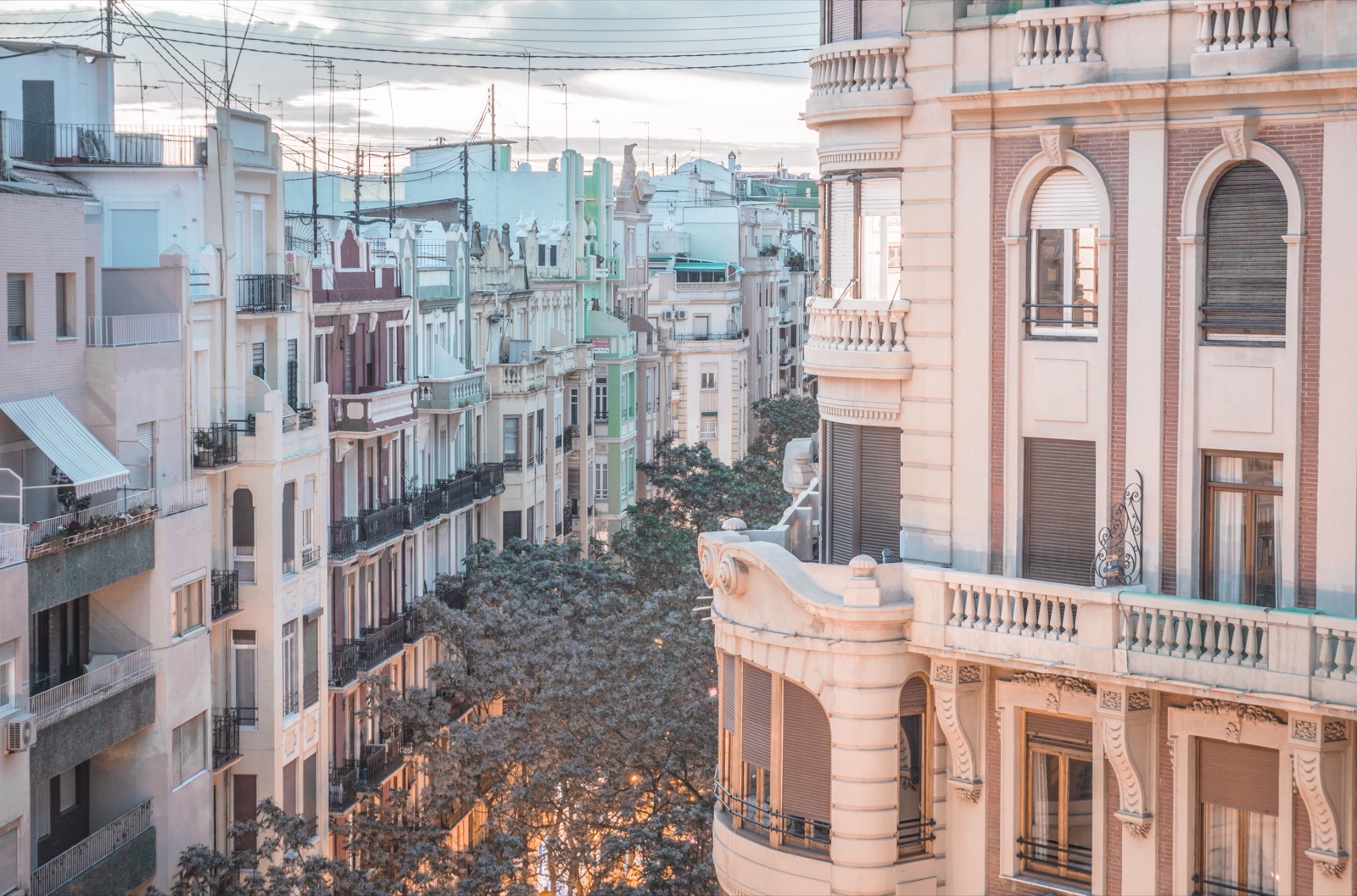
Ciutat Vella and Eixample are the two priciest, most central districts, both running €18-19/m². Ciutat Vella is the walled old town: La Seu and La Xerea cluster around the cathedral, El Carmen is the district’s street-art and nightlife anchor (genuinely noisy at night, worth knowing before you sign), and El Pilar and El Mercat sit around the Mercado Central.
Eixample is the 19th-century grid, and its best-known name is Ruzafa — every source from Uniplaces to US News independently calls it Valencia’s main expat and young-professional neighborhood. What most of that coverage skips: Ruzafa is also the most expensive rental zone in the city, not the affordable hipster pick people assume from the write-ups. El Pla del Remei, in the same district, is upscale and quiet, built around Colón Market’s high-end shopping. Gran Vía is wide, elegant boulevards, more residential and institutional than Ruzafa’s bar-and-café density.
A popular district like Ruzafa also means competition for listings, and a common frustration once you start calling: here’s why so many messages on Idealista never get a reply, and what to do differently.
Just outside the walls: Extramurs and El Pla del Real
Extramurs (€15.6/m²) and El Pla del Real (€16.7/m²) sit just beyond the old center — quieter, still walkable in, and meaningfully cheaper than either historic district. Extramurs centers on El Botànic, next to the university’s botanical garden, with La Roqueta, La Petxina, and Arrancapins as underrated, largely residential value plays.
El Pla del Real is leafy and upper-middle-class: Mestalla (the football stadium’s namesake neighborhood), the Jardines del Real park, and a population skewed toward academics and families near the Blasco Ibáñez university campus.
The university belt: Benimaclet and Algirós
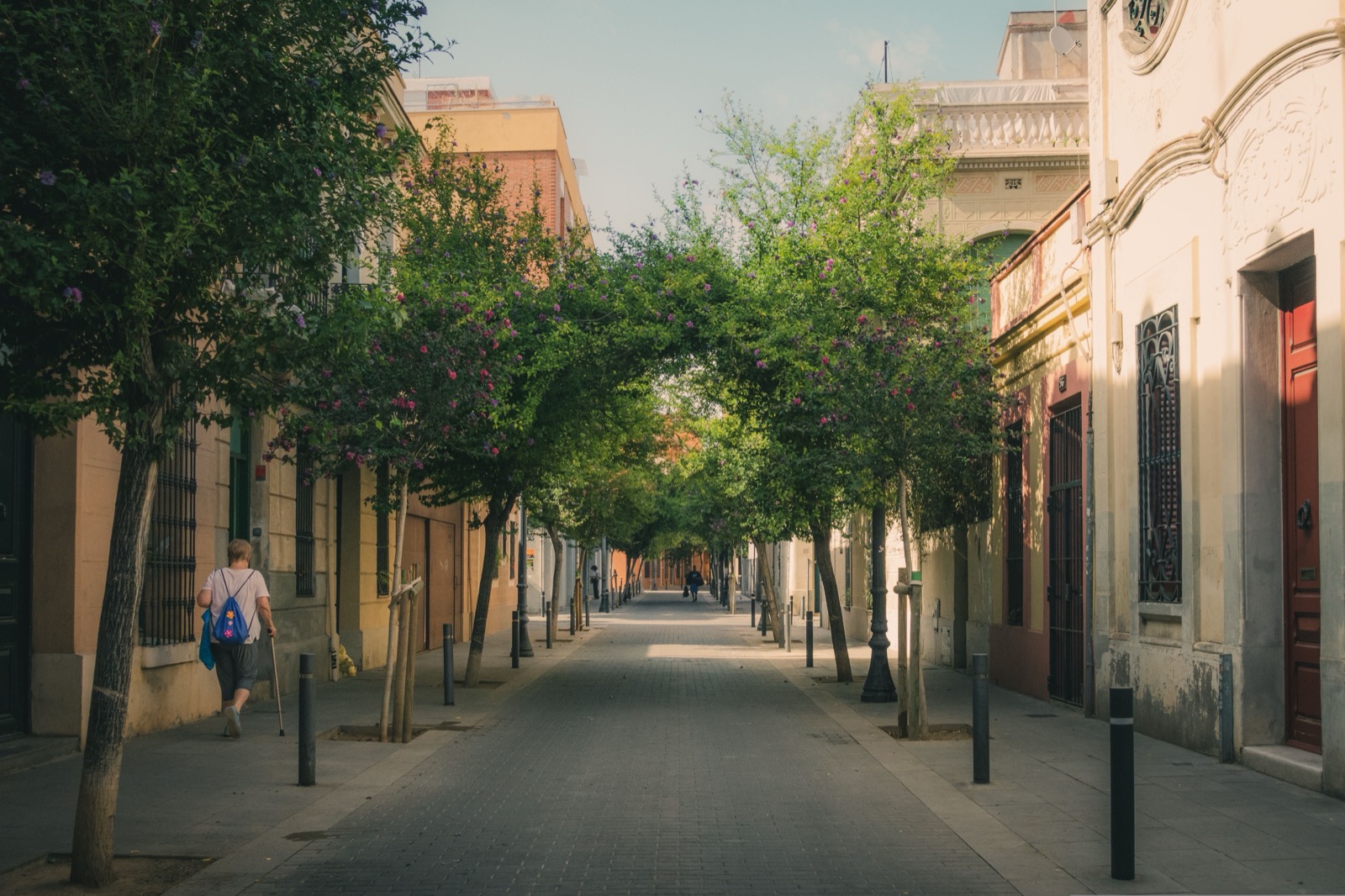
Benimaclet, at €15.1/m², is the cheapest of Valencia’s well-known district names — a former standalone village that kept its small-town feel, a large student population, and a reputation that comes up repeatedly as one of the safest parts of the city. Algirós (€15.5/m²) borders the university on the other side, laid out as a genuine garden city (Ciutat Jardí literally means exactly that) — quiet and family-oriented rather than a nightlife destination.
Southwest, working city: L’Olivereta, Patraix, and Jesús
This is the most affordable cluster with real urban infrastructure, €15.1-16.2/m², and it’s where a lot of ordinary renting happens with essentially zero guidebook presence. L’Olivereta mixes industrial and residential around Nou Moles and Tres Forques. Patraix, a former village like Benimaclet, connects to the new Parque Central extension and is quietly gentrifying without the attention that’s driven up Ruzafa’s prices. Jesús is well-connected to the southern access roads — practical rather than picturesque, and priced accordingly.
East to the sea: Quatre Carreres, Camins al Grau, and Poblats Marítims
Quatre Carreres (€15.3/m²) is home to the Ciudad de las Artes y las Ciencias landmark, a mix of older residential blocks and newer development. Camins al Grau is the connective tissue between the center and the port — mostly residential, rarely mentioned anywhere.
Poblats Marítims (€16.5/m², the priciest of this group) is where the beach lives: El Cabanyal, a former fishermen’s quarter with colorful tiled façades often compared to Havana, still gentrifying and still priced below Ruzafa or El Carmen despite the beachfront location. Malvarrosa is the main beach promenade itself. El Grao is the old port area, and Nazaret, at the southern end, is quieter and more working-class than any of them.
North and the outer edges
La Zaidía, Rascanya, Benicalap, and Campanar sit north of the center — practical, local, largely off the expat map, and noticeably cheaper to buy: Rascanya’s €2,190/m² purchase price is the lowest in the city. La Zaidía is working- and middle-class residential along the old riverbed’s north bank. Rascanya (Orriols, Torrefiel, Sant Llorenç) is affordable and unpretentious. Benicalap centers on a large municipal park and isn’t really on anyone’s radar. Campanar has the Bioparc and the western stretch of the Turia gardens — a mix of old village core and new development, a reasonable pick for families who want green space without beach prices.
Beyond those, Poblados del Norte, del Oeste, and del Sur are former independent villages annexed to the city between 1877 and 1900 — and they’re conspicuously missing from every rental price tracker checked for this guide, which is itself the signal: the formal apartment rental market barely exists out here. Poblados del Norte (Benifaraig, Carpesa, Masarrochos, Borbotó) keeps a huerta, market-garden landscape. Poblados del Oeste (Benimámet, Beniferri) is suburban infill near the ring road. Poblados del Sur runs along the coastal-rural fringe toward the Albufera natural park — El Palmar, the paella-village on the lake, is the best-known name — but this is overwhelmingly houses and seasonal or vacation stock, not a realistic pick if you’re actually apartment-hunting. For a genuinely cheaper option that still has a real rental market, the towns just outside Valencia are worth a look — Aldaia and Quart de Poblet in particular.
If you just want a shortlist
Five barrios cover most of what an expat actually wants out of everything above, if the full nineteen-district tour was more than you needed:
| Barrio | District | Rent | Vibe | Good for |
|---|---|---|---|---|
| Ruzafa | Eixample | highest in the city | bars, cafés, young-professional energy | wanting to be in the middle of it and willing to pay for that |
| Benimaclet | Benimaclet | €15.1/m² — cheapest of the well-known names | ex-village feel, students, quiet streets | budget and safety without landing somewhere anonymous |
| El Cabanyal | Poblats Marítims | below Ruzafa despite the beachfront (district average €16.5/m²) | colorful façades, still gentrifying | beach life without El Carmen’s noise or Ruzafa’s price |
| El Pla del Real | El Pla del Real | €16.7/m² | leafy, upper-middle-class, academic | families and a quieter pace, still close to the center |
| Campanar | Campanar | too thin a rental market for a reliable figure — but cheap | Bioparc, the western Turia gardens, old village core | families who want green space and don’t need the beach |
None of these five are wrong picks. They’re just not the only right ones — which is the whole point of everything above that doesn’t make anyone’s top-five list.
Groceries, dining, transport, and going out
Groceries run €200-300 a person a month, depending on whether you’re shopping at Mercadona or the local mercado. A menu del día lunch costs €10-15, a mid-range dinner for two €40-60, a coffee €1.50-2, and a beer or glass of wine out €2.50-3. A monthly transport pass runs €30-40, and a gym membership €30-40. If you’re on a visa that requires private health insurance, budget €80-100 per person a month for that separately.
Ruzafa isn’t a toll you pay to have a social life in Valencia. Benimaclet and Patraix are a fifteen-minute bike ride from the same bars and restaurants, for noticeably less rent — the premium buys proximity and reputation, not access to the city itself.
None of this changes much district to district — which is exactly why, once you’ve picked a few districts within budget, the real bottleneck becomes finding an available apartment before someone else does, not shaving euros off groceries. The full process — documents, guarantees, and how to move fast once you’ve narrowed it down — is covered here, and it’s worth knowing the red flags of a fake listing before you start calling, not after you’ve paid something you shouldn’t have.
Frequently asked questions
How much do I need to live comfortably in Valencia, Spain?
A single person can live comfortably on €1,600-1,800 a month including rent. A family of four should budget €3,700-4,100 a month all-in — noticeably less than the same household would need in Barcelona.
Is Valencia, Spain a good place for Americans to live?
The cost of living supports it well — rent and dining out run meaningfully below Barcelona or Madrid, and the city has a real beach, a walkable center, and a large enough expat community that you're not starting from zero.
Can you live in Spain with $2,000 a month?
In Valencia specifically, yes, comfortably for a single person, even renting a full one-bedroom in most districts. That budget would be tighter in the priciest parts of Ciutat Vella or Eixample.
Is Spain cheaper to live than the US?
Generally, yes — especially on rent, healthcare, and eating out. Valencia is cheaper again than Spain's bigger cities: a family of four spends noticeably less here than the same household would in Barcelona.
Which neighborhood in Valencia is considered the best? Where do most expats live?
Ruzafa is the most commonly cited expat and young-professional anchor, though it's also the most expensive rental zone in the city, not the budget option people assume. Benimaclet and El Carmen come up almost as often.
Where should I avoid staying in Valencia?
Nowhere is unsafe by Western European standards, but the outer villages (Poblados del Norte, del Oeste, and del Sur) barely have a formal rental market — most housing there is owner-occupied or seasonal, so apartment-hunting there specifically is likely to be a dead end.
What's the cheapest district to live in Valencia?
Among districts with an active rental market, Patraix, Benimaclet, and Jesús consistently come in lowest, around €15/m² — well below Ciutat Vella or Eixample's €18-19/m².