A single person in Barcelona spends €800-1,000 a month excluding rent, a family of four €2,900-3,500 — but that average hides a real range by district. Rent alone can double between Eixample and Nou Barris while groceries and transport barely change. This guide breaks down the monthly cost and tours all 10 of Barcelona’s official districts, not just the well-known handful.
Table of contents
- Monthly budget at a glance: single person vs. family of four
- Ciutat Vella and Eixample: the historic core
- Sants-Montjuïc and Les Corts
- Sarrià-Sant Gervasi and Gràcia
- Horta-Guinardó and Nou Barris
- Sant Andreu and Sant Martí
- Groceries, dining, transport, and clothing
- Per person vs. per family: adjusting the numbers
- Frequently asked questions
Monthly budget at a glance: single person vs. family of four
Excluding rent, a single person in Barcelona spends €800-1,000 a month, according to Numbeo’s cost-of-living index for Barcelona (€816.8) and HousingAnywhere (€800) — close enough to treat as one range rather than two competing numbers. A family of four runs €2,900-3,500 a month, also excluding rent (Numbeo: €2,946.6; HousingAnywhere: €2,880).
The figure that trips people up isn’t the budget itself — it’s whether rent is already baked into it. Half the sources you’ll find don’t say, and the other half don’t agree with each other because of it.
Some sources quote higher totals because they fold rent in from the start — Expatistan’s €4,252 family figure, for instance, includes rent, which is why it looks so different from the Numbeo and HousingAnywhere numbers above. A one-bedroom runs €1,150-1,800 a month depending on the district; a three- or four-bedroom €1,700-2,500. Here’s the estimated monthly rent by district and apartment size:
| District | 1BR | 2BR | 3-4BR |
|---|---|---|---|
| Eixample | €1,250 | €1,800 | €2,500 |
| Sarrià-Sant Gervasi | €1,250 | €1,800 | €2,500 |
| Sants-Montjuïc | €1,200 | €1,750 | €2,400 |
| Sant Martí | €1,200 | €1,750 | €2,400 |
| Ciutat Vella | €1,150 | €1,700 | €2,300 |
| Les Corts | €1,100 | €1,600 | €2,200 |
| Gràcia | €1,100 | €1,600 | €2,200 |
| Horta-Guinardó | €950 | €1,400 | €1,950 |
| Sant Andreu | €900 | €1,300 | €1,750 |
| Nou Barris | €850 | €1,250 | €1,700 |
These are estimates built from each district’s average €/m² asking price (55m² for a 1BR, 80m² for a 2BR, 110m² for a 3-4BR), not listings-based averages — a starting point for budgeting, not a quote.
Ciutat Vella and Eixample: the historic core
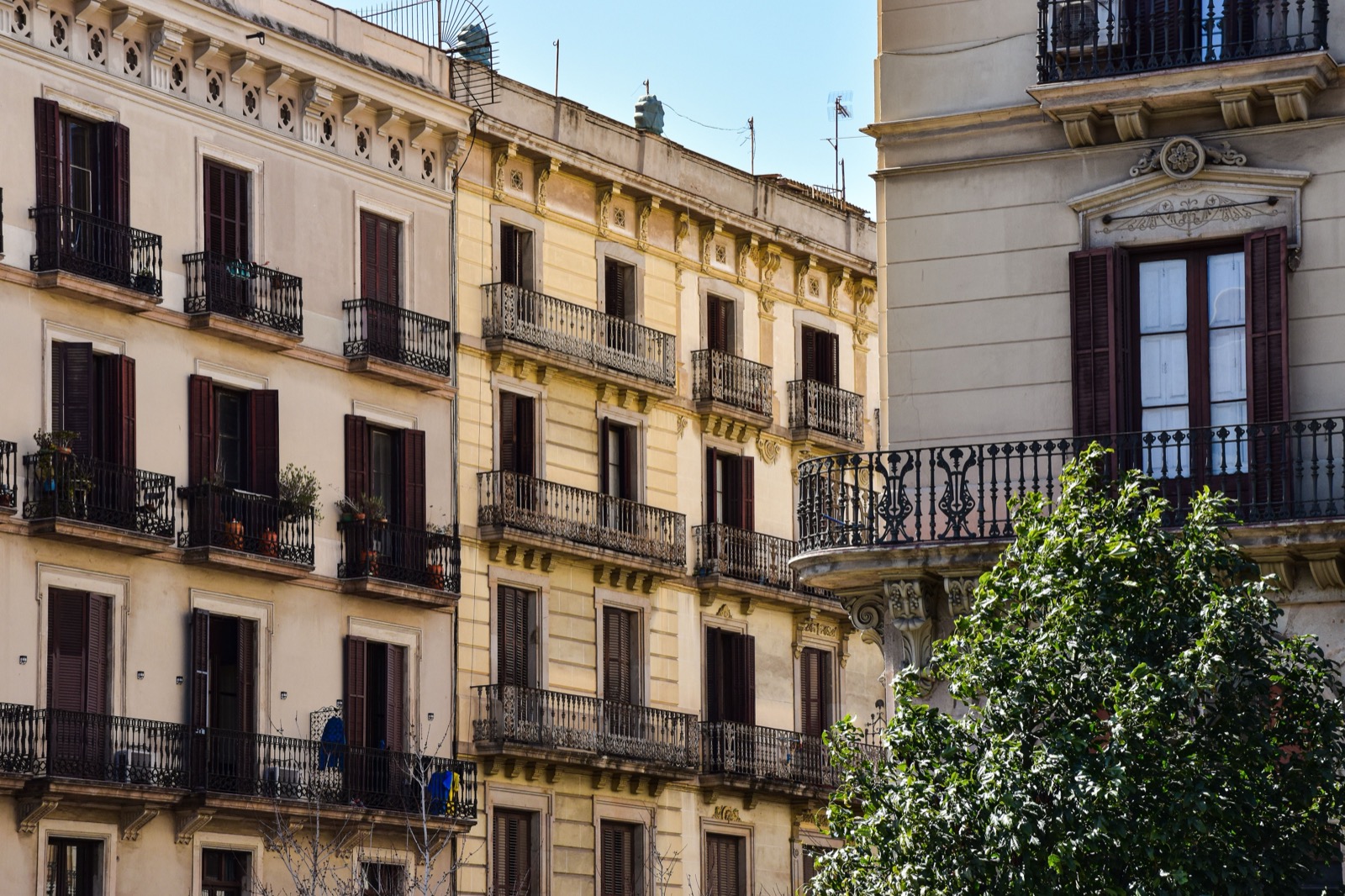
Ciutat Vella is Barcelona’s old town, and its four barrios cover very different characters: El Raval is dense and mixed, the Barri Gòtic is the medieval tourist core, La Barceloneta is the old fishing quarter right on the beach, and Sant Pere-Santa Caterina-La Ribera sits next to the Picasso Museum. It’s central and walkable, and also the most tourist-saturated part of the city.
Eixample, the 19th-century grid, is Barcelona’s most expensive district and its best-known name — the Dreta de l’Eixample around Passeig de Gràcia and the Sagrada Família barrio drive that reputation, while Sant Antoni and the Esquerra de l’Eixample run a little more residential and slightly less expensive without losing the grid’s walkability.
Sants-Montjuïc and Les Corts
Sants-Montjuïc is Barcelona’s largest district by area, stretching from Poble Sec’s bars up against Montjuïc mountain down to the industrial port barrios like La Marina del Prat Vermell. Sants itself, around the main train station, is a practical, well-connected residential hub — less scenic than the postcard neighborhoods, genuinely convenient.
Les Corts is the city’s smallest district and one of its most upscale: Pedralbes is old-money Barcelona, home to the monastery and several university campuses, while the Les Corts barrio itself is quieter and more residential, built around Camp Nou.
Sarrià-Sant Gervasi and Gràcia

Sarrià-Sant Gervasi is Barcelona’s most expensive residential district, uphill and leafy: Sarrià keeps a village feel of its own, Les Tres Torres and Sant Gervasi-La Bonanova are quietly wealthy, and Vallvidrera-Tibidabo up at the top of the district trades convenience for genuine green space and views over the whole city.
Gràcia, by contrast, was an independent town until 1897 and never entirely lost that identity — Vila de Gràcia is the plaza-and-terrace heart of it, popular with a younger, artier crowd than Sarrià-Sant Gervasi despite sitting right next door.
Horta-Guinardó and Nou Barris
Horta-Guinardó is hilly, green, and largely residential — El Carmel and El Guinardó are workaday and affordable, while Horta itself, the district’s namesake, keeps a village character with some of the best value for space in the city. It barely registers in most expat-facing guides, which is more about visibility than anything wrong with the area.
Nou Barris is consistently the cheapest of Barcelona’s 10 districts — a cluster of largely working-class barrios (Verdun, La Prosperitat, Ciutat Meridiana among them) on the northern edge of the city, well served by metro but genuinely peripheral, with little tourist or expat presence.
Sant Andreu and Sant Martí
Sant Andreu was its own municipality until 1897, and the Sant Andreu barrio still has that small-town center, with La Sagrera developing fast around a major new transit hub. It’s traditional, working- to middle-class, and one of the more affordable districts still inside the city proper.
Sant Martí runs along the coast and includes Poblenou — a former industrial zone turned tech and startup hub, now one of the fastest-gentrifying parts of the city — plus the Vila Olímpica’s beachfront apartments from the 1992 Olympics. Prices here have caught up to some of the historic center’s, driven by that same gentrification.
Groceries, dining, transport, and clothing
Groceries run €300-350 per person a month, and this barely moves by neighborhood — a supermarket in Nou Barris and one in Eixample charge close to the same prices. Utilities for an average flat run around €100 a month, and public transport €25-80 depending on whether you buy single tickets or a monthly card.
A beer at a local bar runs €2.50-4, a mid-range dinner for two around €60, and two nights out a week adds up to roughly €80-130 a month. Fashion runs about 8% cheaper than the EU average, with Zara specifically 20-30% below US prices — €40-60 a month is a reasonable estimate for basics, treated as a planning number, not a fact someone measured.
These figures assume a standard long-term lease. Short stays and seasonal contracts run by different rules entirely, often at a markup that makes this whole budget look conservative. Renting in nearby Valencia runs meaningfully cheaper across the board if the city itself isn’t the requirement — we cover that comparison in detail here.
Per person vs. per family: adjusting the numbers
A single person renting a room in a mid-range district, budgeting groceries, transport, and a couple of nights out a week, lands close to €1,450-1,650 a month all-in — €650 rent, €800-1,000 living costs. A family of four in a full apartment in a mid-tier district lands closer to €4,300-5,100 — €1,400-1,600 rent plus the €2,900-3,500 living budget from the top of this guide.
Stop treating the Barcelona city line like a cliff edge. The real budget lever isn’t cutting groceries or going out less — it’s the district. Moving from Eixample to Nou Barris or Sant Andreu can cut your single biggest cost by 30-40% without changing anything else about how you live.
If you’ve read this far, you’re probably still deciding whether to move, not calling agencies yet — fair enough, that’s what this guide is for. Once you’ve got a realistic budget and a district in mind, the next bottleneck is finding an actual apartment before someone else does: each listing gets roughly 40 contacts before it’s taken down, and documents landlords ask for matter as much as budget once you’re calling. If your Spanish is shaky, here’s what to say when the agent only speaks Spanish — but that’s a problem for a different day than this one.
Frequently asked questions
What salary do you need to live in Barcelona?
For a single person, a net salary of around €2,000-2,200 a month covers rent on a full apartment plus a comfortable budget. Sharing a room drops that floor significantly — closer to €1,300-1,500.
Is it cheaper to live in Spain or the US?
Generally cheaper, especially on rent, groceries, and clothing — fashion in Spain runs about 8% below the EU average, and Zara specifically is 20-30% cheaper than in the US. Salaries also run lower, so the comparison depends on whether your income is Spanish or foreign.
Is 3,000 euros a good salary in Barcelona?
Yes — comfortably above what a single person needs, and enough for a family of four to live well outside the most expensive neighborhoods. It's toward the higher end of local salaries, not just adequate.
Can you live on $2,000 a month in Spain?
In Barcelona specifically, it's tight but possible for a single person if you share a room or live in a cheaper district like Nou Barris or Sant Andreu. A full apartment in Eixample would eat most of that budget on rent alone.
Is 100 euros a day enough in Barcelona?
For a visitor covering accommodation, food, and going out, yes, comfortably. For a resident's monthly budget, that would be about €3,000 a month — well above what most locals actually spend.
Is Barcelona cheap for alcohol?
A beer at a local bar runs €2.50-4, and from a supermarket €0.70-1.30 a bottle — cheap by Western European standards. Tourist-area bars and nightclubs run several times higher, so where you drink matters more than what.
Is Zara cheaper in Spain than the US?
Yes, by 20-30%, since it's produced and sold closer to home with fewer import costs. Fashion overall in Spain runs about 8% below the EU average.
What are the official districts of Barcelona?
Ten: Ciutat Vella, Eixample, Sants-Montjuïc, Les Corts, Sarrià-Sant Gervasi, Gràcia, Horta-Guinardó, Nou Barris, Sant Andreu, and Sant Martí — each made up of several smaller barrios.